ROTARY INTERNATIONAL
ORIGIN, PAUL HARRIS & GLOBAL IMPACT
From a cold winter evening in Chicago in 1905 to a 1.4-million-member worldwide humanitarian force. Discover how four friends invented a new form of fellowship that eradicated diseases, built peace, and gave birth to the global Rotaract youth movement.
1905
Founded in Chicago
1.4M+
Global Members
46,000+
Clubs Worldwide
99.9%
Polio Eradicated
Historical Genesis • February 23, 1905
HOW ROTARY STARTED: ROOM 711, UNITY BUILDING
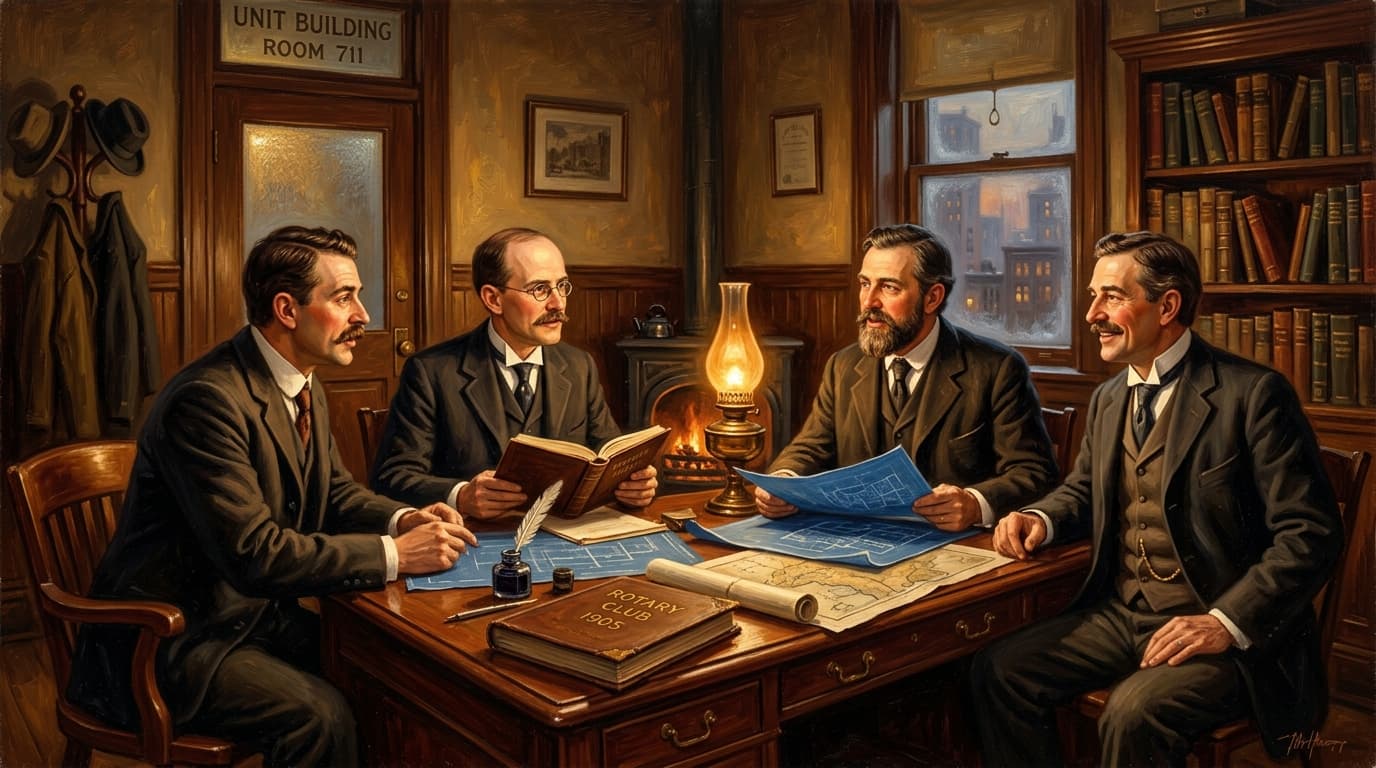
The Inaugural Assembly — February 23, 1905
Room 711, Unity Building, 127 N Dearborn St, Chicago, Illinois
At the turn of the 20th century, Chicago was a booming industrial metropolis—dynamic, aggressive, but profoundly impersonal. Young professionals arriving from idyllic rural towns often felt isolated in its competitive rush. Among them was Paul Percy Harris, a young attorney originally from Vermont who had spent five years roaming the world before opening his legal practice in Chicago in 1896.
Harris yearned for the genuine fellowship and warmth he had known in his childhood. On the blustery evening of Thursday, February 23, 1905, Harris invited three trusted business acquaintances to gather in Room 711 of the Unity Building, the office of mining engineer Gustavus Loehr.
Their idea was revolutionary in its simplicity: a club composed of one representative from each business and profession, coming together not to exploit one another, but to cultivate sincere personal friendships, broaden their knowledge of other trades, and support one another in business with strict integrity.
Within two short years, fellowship evolved into altruism. In 1907, the young club spearheaded its very first community service project: building a public comfort station (restrooms) near Chicago City Hall. That civic initiative permanently established service as the true soul of Rotary, crystallized in the immortal motto: "Service Above Self".
THE FOUR FOUNDING MEMBERS
Paul P. Harris
Attorney at Law
Conceived the fellowship concept to revive the small-town camaraderie of his youth in bustling Chicago. Served as 1st RI President.
Silvester Schiele
Coal Merchant
Paul's trusted confidant and first formal client in Chicago. Elected the first-ever president of the Rotary Club of Chicago in 1905.
Gustavus H. Loehr
Mining Engineer
Hosted the historic inaugural February 23, 1905 gathering inside his office in Room 711 of the Unity Building on Dearborn Street.
Hiram E. Shorey
Merchant Tailor
Brought craftsmanship, business integrity, and personal camaraderie to the original founding quartet from Vermont roots.
HOW DID THE NAME “ROTARY” COME ABOUT?
The name “Rotary” originated from the practical custom established during the club's earliest weeks: the members rotated their weekly meeting places from one member's office to another.
Because the club had no permanent headquarters, one week they would meet at Silvester Schiele's coal distribution yard, the next week at Hiram Shorey's tailor shop, then at Gustavus Loehr's engineering studio, and later at Paul Harris's law chambers.
Rotating Locations
Visiting each member's workplace gave every member first-hand familiarity with their peers' craft, character, and business ethics.
Rotating Leadership
Just as meetings rotated, leadership and meeting chair responsibilities shifted smoothly among members, preventing cliques and monopoly.
Rotary International
In 1910, the 16 clubs became the National Association of Rotary Clubs. When clubs spanned across Canada and Europe, it was officially renamed Rotary International (RI) in 1922.
The Visionary & First President
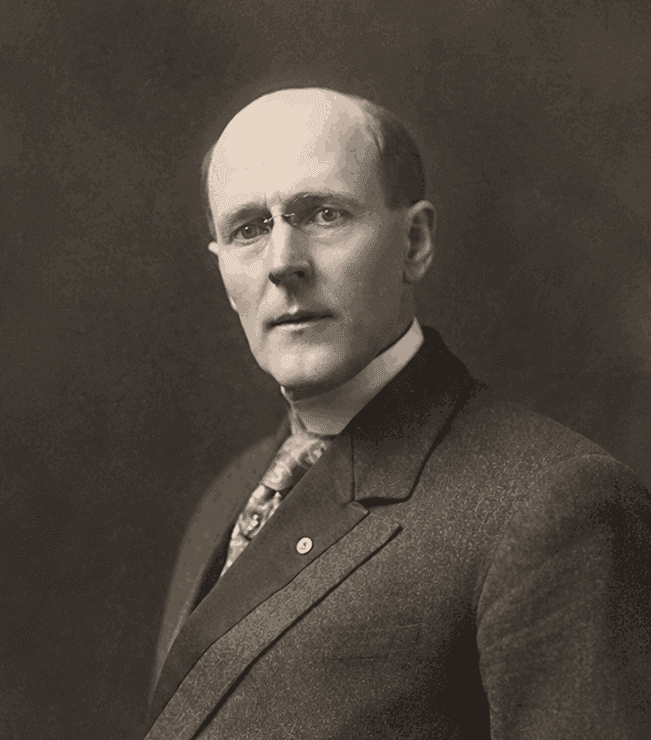
PAUL PERCY HARRIS
April 19, 1868 – January 27, 1947
Founder of Rotary International & 1st RI President (1910–1912)
Established in 1957 in Harris's memory, the Paul Harris Fellow recognition honors individuals who contribute (or in whose name is contributed) $1,000 to The Rotary Foundation to fund life-changing humanitarian programs globally.
PAUL HARRIS: THE LAWYER WHO UNITED THE WORLD
Small-Town Vermont Roots to Global Statesmanship
Paul Percy Harris was born on April 19, 1868, in Racine, Wisconsin. At age three, following economic difficulties in his family, he was brought to Wallingford, Vermont, to be raised by his paternal grandparents, Howard and Pamela Harris. In this quintessential New England hamlet, Paul absorbed deeply the virtues of tolerance, neighborly mutual help, and egalitarian respect for every person.
After graduating with a law degree from the University of Iowa in 1891, Paul took an unconventional vow: he decided to spend five full years traveling across the United States and abroad to study human nature before entering legal practice. During this wandering half-decade, he worked as a newspaper reporter in San Francisco, a cowboy in Colorado, a marble counter in Kentucky, a granite salesman, and a deckhand on transatlantic cattle freighters bound for England.
When he finally hung his shingle in Chicago in 1896, his worldly perspective shaped his dream: Why not create a fraternity of professionals that transcended religious, political, and national boundaries?
“This is a world of change and we must be prepared to change with it. The story of Rotary will have to be written again and again.”
— Paul P. Harris, This Rotarian Age (1935)
THE ROTARY WHEEL: 24 COGS & THE KEYWAY
Rotary's first emblem was designed in 1905 by Chicago Rotarian Montague M. Bear—a simple wagon wheel rolling on a bed of dust, representing civilization and forward motion.
However, engineers soon noted that a wagon wheel was static and idle. In 1923, the Rotary International board officially codified the emblem we recognize today: a gear wheel with 24 cogs, 6 spokes, and a keyway.
The keyway cut into the hub is the defining philosophical element: it signifies that the wheel is keyed to an active power shaft, transmitting torque and work to the machinery of humanity, rather than spinning idly in space.
Humanitarian Footprint
GLOBAL ACHIEVEMENTS OF ROTARY
Over a century of tangible, verifiable humanitarian milestones transforming nations and generations.
99.9% ERADICATION OF POLIO ACROSS PLANET EARTH
In 1985, polio paralyzed over 350,000 children every single year in more than 125 countries. Rotary launched PolioPlus, spearheading the Global Polio Eradication Initiative with the World Health Organization, US CDC, UNICEF, and later the Bill & Melinda Gates Foundation.
Rotarians have contributed over $2.6 Billion and countless volunteer hours, helping immunize over 3 billion children in 122 countries. Today, wild poliovirus remains endemic in only two nations (Afghanistan and Pakistan), standing on the precipice of becoming only the second human disease ever eradicated after smallpox.
3B+
Children Vaccinated
$2.6B+
Direct Investment
The Rotary Foundation
Started in 1917 with Arch Klumph's initial $26.50 donation, the Foundation has distributed over $4 Billion in global grant projects, consistently receiving Charity Navigator's highest 4-star rating for financial stewardship.
Rotary Peace Fellowships
Established Rotary Peace Centers at premier universities worldwide (Duke/UNC, Bradford, ICU Japan, Uppsala, Makerere). Over 1,700 fellows now lead peace negotiations, refugee rehabilitation, and policy reform in the UN and global governments.
Role in the United Nations
In 1945, 49 Rotarians served as delegates, advisors, and consultants at the charter conference of the United Nations in San Francisco, writing the UNESCO charter and embedding human rights into the UN Charter.
ROTARY'S SEVEN AREAS OF FOCUS
Peacebuilding & Conflict Prevention
Training 1,700+ Rotary Peace Fellows mediating international disputes.
Disease Prevention & Treatment
Leading the PolioPlus global drive reducing polio by 99.9% worldwide.
Water, Sanitation & Hygiene (WASH)
Building sustainable clean water systems for millions in underserved areas.
Maternal & Child Health
Providing medical supplies, prenatal clinics, and healthcare infrastructure.
Basic Education & Literacy
Empowering children and women with schools, books, and digital learning.
Community Economic Development
Issuing microloans and vocational mentorship to spark local entrepreneurship.
Supporting the Environment
Reforestation, solar energy drives, and coastal cleanup initiatives globally.
THE 4-WAY TEST
Created in 1932 by Rotarian Herbert J. Taylor to rescue a bankrupt aluminum company during the Great Depression. Translated into 100+ languages:
Is it the TRUTH?
Uncompromising integrity, transparency, and authenticity in every spoken word and business commitment.
Is it FAIR to all concerned?
Equitable decision-making free of bias, ensuring all parties are respected, honored, and justly treated.
Will it build GOODWILL and BETTER FRIENDSHIPS?
Deepening empathy, bridging cultural divides, and forging enduring bonds of human connection.
Will it be BENEFICIAL to all concerned?
Driving constructive outcomes that enrich lives, uplift communities, and leave no one diminished.
The Youth Movement • 1968 to Today
FROM ROTARY TO ROTARACT: ROTARY IN ACTION
In 1968, recognizing that college students and young professionals possessed unbridled energy and vision, Rotary International chartered the first Rotaract Club in Charlotte, North Carolina. Combining the words “Rotary” and “Action”, Rotaract became the dynamic youth movement of the Rotary family.
In 2020, Rotary International officially elevated Rotaract into a full membership category, recognizing Rotaractors as equal partners in world service. Here in Coimbatore, the Rotaract Club of Coimbatore Cosmopolitan (Chartered 2014, District 3206) carries forward Paul Harris's flame through active environmental drives, education funding, and youth leadership.